미분기하학에서 아티야-싱어 지표 정리(-指標定理, 영어: Atiyah–Singer index theorem)는 타원 복합체의 지표를 위상학적인 데이터로 계산할 수 있다는 정리다.[1][2][3]:§10–11[4][5][6][7]:§12.8, 477–480; §12.10, 487–500[8][9] 히르체브루흐-리만-로흐 정리와 가우스-보네 정리 등을 일반화한다.
 이
이  차원 콤팩트 매끄러운 다양체이고,
  가 위의 매끄러운 벡터 다발들이라고 하자. 위의 타원 복합체

의 해석적 지표(analytical index)는 다음과 같다.

이는 순수하게 해석적인 데이터로 정의된 값이다. 여기서  는 프레드홀름 지표이다.
타원 복합체의 위상 지표(영어: topological index)는 다음과 같다.[7]:Theorem 12.2

여기서
 는 매끄러운 벡터 다발의 천 지표이다.
 는 의 접다발
  의 복소화의 토드 특성류이다.
 은 접다발 의 오일러 특성류이다.
이 지표는 순수하게 위상수학적인 데이터로 정의된 값이다.
아티야-싱어 지표 정리에 따르면, 타원 복합체의 해석적 지표와 위상 지표는 같다.
여기서,  이 홀수인 경우 (미분 연산자에 대하여) 양변 모두 0이다. (다만, 유사 미분 연산자에 대한 경우 홀수 차원에서도 자명하지 않은 결과를 도출할 수 있다.)
특히, 하나의 프레드홀름 미분 연산자

에 대하여, 이를 타원 복합체

로 간주하면, 다음을 얻는다.

수많은 유명한 정리들을 아티야-싱어 지표 정리의 특수한 경우로 얻을 수 있다.
오일러 지표[편집]
이 콤팩트 유향 다양체라고 하고, 지표 정리를 (복소화한) 드람 복합체

에 적용시키자. 드람 복합체의 해석적 지표는 다양체의 오일러 지표  이다. 그 위상 지표는 오일러 특성류
  의 적분이다. 즉, 이에 따라 천-가우스-보네 정리(영어: Chern–Gauss–Bonnet theorem)
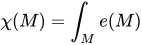
를 얻는다.
계산:
미분 형식 벡터 다발의 천 지표는 분할 원리를 사용하여 계산하면 다음과 같다.

여기서  는
는  를 분할 원리로 개의 복소수 선다발들의 직합이라고 가정할 때
  번째 복소수 선다발의 1차 천 특성류이다. 이는 실수 벡터 다발의 복소화이므로
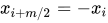
로 놓을 수 있다.
즉

이다. 토드 특성류와 오일러 특성류는 각각
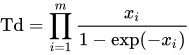

이므로, 지표 밀도는

이다.
히르체브루흐-리만-로흐 정리[편집]
아티야-싱어 지표 정리를 돌보 복합체에 적용시키면 히르체브루흐-리만-로흐 정리를 얻게 된다.
이 복소다양체라고 하고, 그 위에 해석적 벡터 다발  가 주어졌다고 하자. 지표 정리를 돌보 복합체
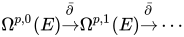
에 적용시키자. 돌보 복합체의 해석적 지표는 의 코호몰로지의 오일러 지표

이고, 그 위상 지표는
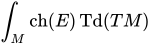
이다. 따라서 이는 히르체브루흐-리만-로흐 정리가 된다.
계산:
복소수 차원이  라고 하자.
분할 원리에 따라, 복소수 접다발이 복소수 선다발의 직합이라고 하자.
라고 하자.
분할 원리에 따라, 복소수 접다발이 복소수 선다발의 직합이라고 하자.

또한

라고 하자. 그렇다면

이며, 따라서

이다.
이제


이므로, 지표 밀도는

이다.
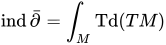
가 0차원 벡터 다발인 경우, 그 오일러 지표는 복소다양체의 산술 종수  이다. 따라서, 복소다양체의 산술 종수는 복소 접다발의 토드 특성류의 적분에 의하여 주어진다.
디랙 연산자[편집]
이 짝수 차원의 스핀 다양체라고 하고, 그 위에 스피너 다발

을 생각하자. 그렇다면 디랙 연산자
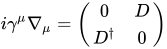
는 다음과 같이 작용한다.
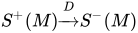
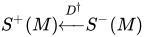
이에 따라, 디랙 연산자  의 지표는 아티야-싱어 지표 정리에 따라 다음과 같다.

여기서  는 디랙 종수(영어: Dirac genus) 또는 Â 종수(영어: Â-genus 에이 햇 지너스[*])라고 불리는 특성류로,

이다. 여기서  는 폰트랴긴 특성류이고, 는 2차 미분 형식들의 행렬인 곡률
  의 고윳값들
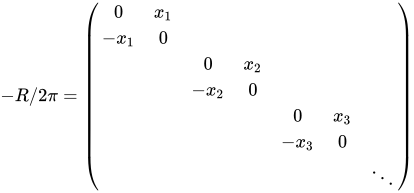
이다. 일반적으로, 디랙 종수는 스핀 다양체가 아닌 다른 다양체의 경우 정수가 아닐 수 있다.
마이클 아티야와 이자도어 싱어가 1963년에 발표하였다.[10][11][12][13][14] 부분적으로 이 공로로 마이클 아티야는 1966년 필즈상을 수상하였다.[15] 이 공로로 마이클 아티야와 이자도어 싱어는 2004년 아벨상을 수상하였다.[16][17][18]
1983년에 루이스 알바레스가우메(스페인어: Luis Álvarez-Gaumé)가 아티야-싱어 지표 정리가 초대칭 양자역학과 깊은 관계가 있다는 사실을 밝혔고, 이를 이용하여 아티야-싱어 정리를 새롭게 증명하였다.[19][20] 이 증명은 그 뒤 에즈라 게츨러(영어: Ezra Getzler)가 수학적으로 엄밀하게 제시하였다.[21] 즉, 디랙 연산자의 경우, 그 해석적 지표는 단순히 위튼 지표에 불과하여, 초대칭 양자역학을 사용해 계산할 수 있다.
참고 문헌[편집]
- ↑ 조용승 (2012). 《지표이론》. 경문사. ISBN 978-89-6105-622-9. 2014년 11월 12일에 원본 문서에서 보존된 문서. 2013년 8월 26일에 확인함.
- ↑ 지동표 (1983년 11월 1일). 《국소적 형태의 Atiyah-Singer 지표이론》. 민음사. ISBN 89-374-3509-8.
- ↑ 조용승 (1999년 4월 20일). 《다양체의 미분위상수학》. 아르케. ISBN 978-89-88791-11-0. 2017년 1월 10일에 원본 문서에서 보존된 문서. 2017년 1월 10일에 확인함.
- ↑ 김홍종 (1996). 〈6. 아티야-싱어의 지표 이론〉. 《이론물리의 수학적 접근》. 대우학술총서 공동연구 37. 민음사. 163–188쪽. ISBN 89-37445-34-4.
- ↑ Shanahan, Patrick (1978). 《The Atiyah–Singer index theorem: an introduction》. Lecture Notes in Mathematics (영어) 638. Springer. doi:10.1007/BFb0068264. ISBN 978-3-540-08660-4. ISSN 0075-8434.
- ↑ Melrose, Richard B. (1993년 3월 31일). 《The Atiyah–Patodi–Singer index theorem》 (PDF). Research Notes in Mathematics (영어) 4. A. K. Peters/CRC Press. ISBN 978-1-568-81002-7.
- ↑ 가 나 Nakahara, Mikio (2003년 6월 4일). 《Geometry, topology and physics》 (영어) 2판. Taylor & Francis. doi:10.1201/9781420056945. ISBN 978-0-7503-0606-5.
- ↑ Booß, Bernheim; David D. Bleecker (1985). 《Topology and analysis: the Atiyah–Singer index formula and gauge-theoretic physics》. Universitext (영어). Springer. doi:10.1007/978-1-4684-0627-6. ISBN 978-0-387-96112-5. ISSN 0172-5939. MR 0771117.
- ↑ Palais, Richard S.; Atiyah, Michael F.; Borel, A.; Floyd, E. E.; Seeley, R. T.; Shih, W.; Solovay, Robert (1965). 《Seminar on the Atiyah–Singer index theorem》 (PDF). Annals of Mathematics Studies (영어) 57. Princeton University Press. ISBN 9780691080314. MR 0198494.
- ↑ Atiyah, M. F.; Singer, Isadore M. (1963). “The index of elliptic operators on compact manifolds”. 《Bulletin of the American Mathematical Society》 (영어) 69: 422–433. doi:10.1090/S0002-9904-1963-10957-X.
- ↑ Atiyah, M. F.; Singer, Isadore M. (1968a). “The index of elliptic operators I”. 《Annals of Mathematics》 (영어) 87 (3): 484–530. doi:10.2307/1970715. JSTOR 1970715.
- ↑ Atiyah, M. F.; Singer, Isadore M. (1968b). “The index of elliptic operators III”. 《Annals of Mathematics》 (영어) 87 (3): 546–604. doi:10.2307/1970717. JSTOR 1970717.
- ↑ Atiyah, M. F.; Singer, Isadore M. (1971). “The index of elliptic operators IV”. 《Annals of Mathematics》 (영어) 93 (1): 119–138. doi:10.2307/1970756. JSTOR 1970756.
- ↑ Atiyah, M. F.; Singer, Isadore M. (1971). “The index of elliptic operators V”. 《Annals of Mathematics》 (영어) 93 (1): 139–149. doi:10.2307/1970757. JSTOR 1970757.
- ↑ Albers, Donald J.; Alexanderson, G. L.; Reid, Constance (1986). 《International mathematical congresses: An illustrated history 1893–1986》 (영어) 개정판. New York: Springer-Verlag. 2013년 12월 3일에 원본 문서에서 보존된 문서. 2012년 11월 24일에 확인함.
- ↑ “Atiyah and Singer Receive 2004 Abel Prize” (PDF). 《Notices of the American Mathematical Society》 (영어) 51 (6): 649–650. 2004년 6월.
- ↑ Hitchin, Nigel (2010). 〈The Atiyah–Singer index theorem〉. 《The Abel Prize 2003–2007: the first five years》 (영어). Springer-Verlag. 117–152쪽. doi:10.1007/978-3-642-01373-7_7. ISBN 978-3-642-01372-0.
- ↑ Raussen, Martin; Skau, Christian (2005년 2월). “Interview with Michael Atiyah and Isadore Singer” (PDF). 《Notices of the American Mathematical Society》 (영어) 52 (2): 223–231.
- ↑ Alvarez-Gaumé, Luis (1983). “Supersymmetry and the Atiyah-Singer index theorem”. 《Communications in Mathematical Physics》 (영어) 90 (2): 161–173. doi:10.1007/BF01205500.
- ↑ Alvarez-Gaumé, Luis (1984년 3월). “Supersymmetry and the Atiyah-Singer index theorem”. 《Physica A: Statistical Mechanics and its Applications》 (영어) 124 (1–3): 29–45. doi:10.1016/0378-4371(84)90224-3.
- ↑ Getzler, Ezra (1986). “A short proof of the local Atiyah-Singer index theorem” (PDF). 《Topology》 25 (1): 111–117. doi:10.1016/0040-9383(86)90008-X. MR 836727. 2015년 3월 26일에 원본 문서 (PDF)에서 보존된 문서. 2013년 8월 9일에 확인함.
외부 링크[편집]



 이 부분의 본문은 히르체브루흐-리만-로흐 정리입니다.